
Free Agent Frenzy
Undervalues MLB Free Agents

Marcell Ozuna | All-Pro Reels Photography | Wikimedia Commons
Baseball free agency is upon us, and each winter the value of MLB free agents is a source of debate. Unlike other salary-capped sports, the lack of a spending cap (and floor) in baseball leads to massive differences in free agent spending and valuation across teams. While the biggest stars on the market make the most headlines, the smartest teams scour every corner of the free agent market looking for value.
Using CSA’s relevance-based prediction methodology, we identified some of the under-the-radar free agents who are likely to deliver a favorable return on investment. The projected contract for each player is courtesy of FanGraphs’ crowdsourced contract market, and the WAR-to-dollars conversion was made with the value of 1 Win Above Replacement being worth $8 million dollars. Health is a key assumption, as the WAR values are prorated to a full season to account for the unpredictability of injuries. The player stats used in the predictions are a playing-time weighted average over their past three seasons, with more recent seasons receiving a higher weight.
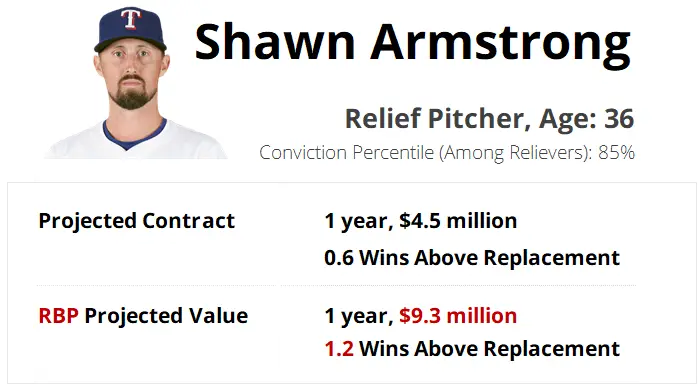
Small contracts for older relievers work out more often than you may think. Every year, older relievers who sign for shorter deals with lower AAVs end up pitching important playoff innings. This past season relievers like Aroldis Chapman, Kyle Finnegan, and Caleb Thielbar played key bullpen roles on playoff teams after being free agents in the 2024-25 offseason. Armstrong looks like a strong candidate to exceed his projected contract in 2026.

Interestingly, Armstong’s (older) age increases both his prediction and the conviction in his prediction, which aligns with the idea that older relievers work out more often than anticipated. Over his past three seasons, he has sandwiched a slight down year in between two very strong performances out of the bullpen. Armstrong excels not with velocity, but with limiting contact. In his 2023 and 2025 seasons, he posted hard hit rates and average exit velocities above the 80th percentile. He supplements his soft-contact style with above average walk and strikeout rates, making him a good bet to outdo his 1-year, $4.5 million dollar projection.

In the table, you can see some of the notable contracts that played key roles in forming Armstrong’s prediction - all short-term deals signed by older relievers.
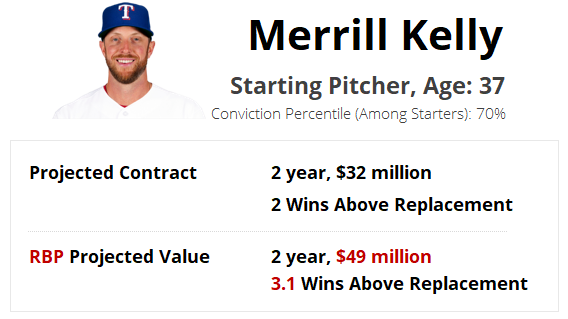
The market projects Kelly to produce a WAR per season of 2.0, while CSA predicts he will be around 3.1 during his contract time frame. Kelly has been a modern-day workhorse over the past four seasons, as he has made 30 or more starts in three out of those four seasons.

Since 2022, he ranks in the top 30 in both starts made and innings pitched. While not a strikeout pitcher, Kelly has a solid K-BB% due to his above-average walk prevention. Moreover, his K-BB% is a large contributor that raises both his WAR projection and RBP’s conviction in the prediction. Kelly’s SIERA and ground ball rate also increase both his prediction and conviction, highlighting the importance of his batted ball profile. The similar deals to Kelly’s projected contract highlight veteran starters such as Clayton Kershaw and Bartolo Colon, and those deals suggest that Kelly will be able to remain productive as he ages into his upper 30’s.

Pitchers like Kelly who aren’t reliant on velocity often age somewhat gracefully, as the decline in velocity as they get older doesn’t affect their repertoire as much. Kelly’s fastball velocity in 2025 was just 0.2 MPH lower (on average) than his rookie season in 2019 as a 30-year-old coming to the MLB from the KBO.

For most of his career, Ozuna has been a prolific hitter. A career 20% above-average hitter, Ozuna has posted three consecutive seasons with a wRC+ over 110, including a 154 in 2024 that earned him 4th place in MVP voting. As he has aged, he transitioned from an outfield role to a full-time DH role, which does lower his overall value.

However, the market seems to be too low on Ozuna, with a contract projection that implies a value of 1.5 WAR, while RBP values him at 1.8 WAR. As a full-time DH, the main factors that contribute to Ozuna’s prediction and conviction are all based on his offensive profile. His wRC+ and wOBA increase both his prediction and his conviction. When looking at relevant contracts for Ozuna moving forward, we focused on older hitters who were signed with a DH role in mind.
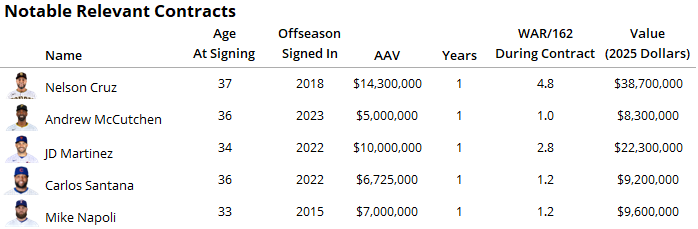
Players like Nelson Cruz, J.D. Martinez, and Andrew McCutchen signed one-year deals with lower AAVs for many years in a row before deciding to retire and remained productive offensively throughout most of those deals. Ozuna has a similar profile to these players, both in terms of where his value comes from and in terms of his projected contract situation moving forward.


Comments