
Future of the Franchise: 2026 NBA Draft Analysis

Each year, NBA franchises come into the draft with the hope of selecting their stars of tomorrow. Potential draftees are often just 18 or 19 years old, making the NBA draft an especially challenging exercise in projection. In other sports like football, draftees are frequently 22 or 23 years old, and the task of projecting a 22-year-old is much different than that of an 18-year-old. Teams pour massive amounts of resources into scouting prospects, using both mathematical models and extensive scouting to gather as much information as possible on every prospect.
Using CSA’s Relevance-Based Prediction tool, we predicted Value Over Replacement Player (VORP) over the first three NBA seasons for prospects in the 2026 draft. VORP is a composite metric of how much more a player contributes to a team compared to a hypothetical replacement player. RBP is remarkably transparent compared to both conventional prediction methods and black-box machine learning models.
We illustrate RBP’s transparency by focusing on two players who are expected to be drafted in the first round, Zuby Ejiofor and Ebuka Okorie. We first focus on variable importance. We show which variables have the greatest impact on the reliability of the prediction and then on the value of the prediction. The gray bars show 20th to 80th percentile range of importance across all the draft prospects. The lines near the middle of the bars represent the median values, while the diamonds and dots show the impact on reliability and impact on value, respectively, for the two players. We also show which former NBA players were most relevant to these predictions.
_____________________________________
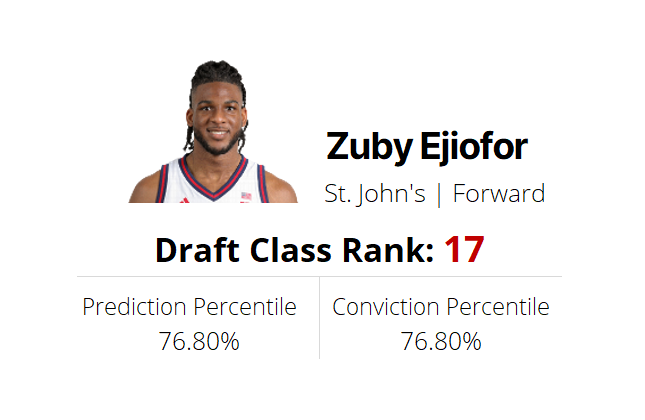
A riser in the draft rankings throughout the college basketball season, Ejiofor ranks 17th in RBP’s predictions for the 2026 draft class. Ejiofor started the season outside the top 100 on most draft boards, but his senior season, in which he was named Big East Player of the Year, changed some minds. He is now considered a late first-round or early second-round pick on most draft boards. RBP ranks him even higher, placing him in the middle of the first round.
Impact on Prediction

Impact on Conviction

Ejiofor’s BLK per 100 is the most important variable for both his prediction and conviction value. Given his size, Ejiofor’s shot blocking numbers are very impressive. However, he is somewhat undersized for the forward/center role he played in college, as his height is a detractor from both prediction and conviction.
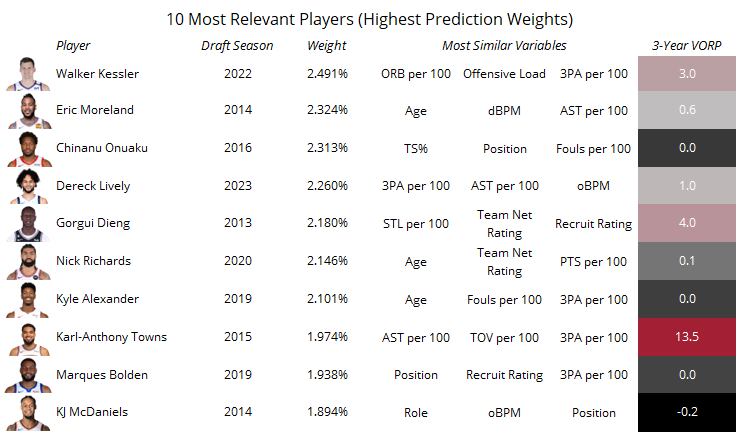
Of Ejiofor’s most relevant players, Karl-Anthony Towns is by far the most notable. While Ejiofor does not possess the unique size that Towns has, he showcased many similar skills as him, including above-average passing ability for a big man and a greater willingness to shoot from the perimeter than most players at his position.
_____________________________________

Like Ejiofor, Okorie did not begin the season on many draft boards. However, his rise was even more meteoric than Ejiofor’s. After starting his college career with scoring performances of 26, 29, 21, and 26 points, Okorie firmly entered the one-and-done conversation for good. Okorie currently ranks as a mid-to-late first round prospect on most draft boards, but RBP views him more as a lottery-pick talent. His conviction value is lower than Ejiofor’s, suggesting a wider range of potential outcomes.
Impact on Prediction

Impact on Conviction

Okorie’s high usage rate is the most important variable for both his prediction and conviction, as RBP believes that his ability to handle a lot of responsibility on offense is a good sign for his NBA future. Okorie is a bit undersized as well, and his height is the biggest detractor from both his prediction and conviction. His turnover rate is another detractor, as he committed turnovers at a relatively high rate in college. However, when adjusted for how often he had the ball in his hands, the negative impact of his turnovers becomes more muted, as reflected by the near-zero importance of Turnovers/USG%.
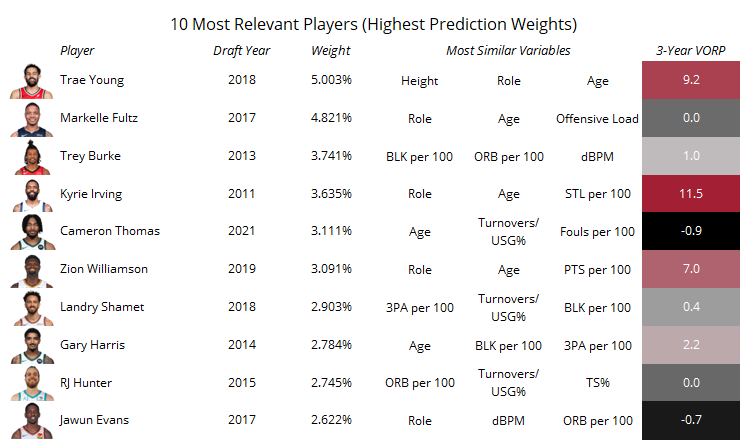
Players who are most relevant to Okorie’s prediction are high usage guards with questions about their defensive skills. Of the players in this category, Trae Young and Kyrie Irving have had very successful NBA careers, while Trey Burke and Cameron Thomas have struggled to secure consistent roles. The most interesting player that is relevant for Okorie is Zion Williamson. While they arrived there through different skill sets, both statistical profiles point to freshmen who were responsible for driving their teams' offenses and creating a large share of their points.

Comments