
Minor League Movers: Baseball Prospects on the Rise

D. Benjamin Miller | Creative Commons Zero, Public Domain Dedication
Each winter, MLB prospects make meaningful changes to their game. Players get stronger, hitters improve their plate discipline, and pitchers add more spin to their breaking balls. However, we don’t see the results of these changes until the new minor league season begins, and even that requires sifting through box scores scattered across many levels of baseball. Most importantly, we don’t know if a player’s improved statistics are indicative of a change in talent level, or just noise that comes from a few weeks of baseball. Some players off to hot starts in the minors will come up to the major leagues and impact playoff races, like Cam Schlittler and Trey Yesavage did in 2025. Others cool down and never follow through on their hot starts.
Using CSA’s award-winning Relevance-Based Prediction technology, we examined the current crop of minor league players’ performances in 2026 and compared our updated predictions of MLB outcomes for each player to our preseason predictions to see which players have had the largest increases in their predictions. Variables considered include a player’s overall output, their batted ball profile, their command of the strike zone, and the player’s experience relative to the level of the minor leagues they are at. We chose to highlight two big risers whose 2026 performance has meaningfully changed their MLB outlook. The ranks shown for each prospect are among current minor league players, so any prospect who has graduated since the season started is not included in either rank. The stat predicted for hitters was career weighted runs created, and the stat predicted for pitchers was career runs above replacement.
A.J. Ewing

A.J. Ewing’s minor league performance in 2026 has increased his hitter prediction ranking from the 93rd best prospect in the preseason to the 3rd best prospect, as well as earning him a recent call up to the majors. The conviction in Ewing’s prediction has also jumped, going from a top 10% conviction value to a top 1% conviction value.

Many of the players most relevant to Ewing’s prediction had long and successful MLB careers. Freddie Freeman, Buster Posey, Carlos Santana, Dexter Fowler, Mike Trout, and Justin Smoak all made at least one All-Star team during their careers. Most of these players relied more on their bat-to-ball skills and plate discipline rather than elite power tools for success. This is the likeliest path to success for Ewing as well, as he had a very high walk rate and batting average in the minor leagues, but not a lot of game power.


Connor Prielipp
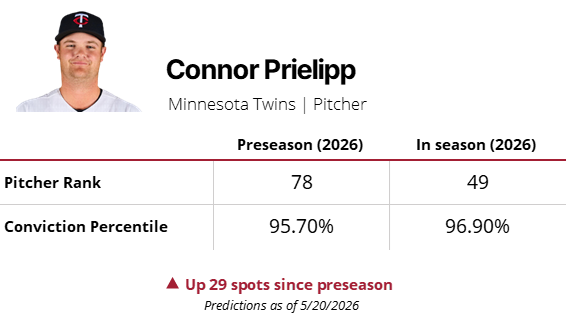
Prielipp entered the year as the 78th ranked pitching prospect, and his early performance has moved him into the top 50. Like Ewing, his performance in AAA this season earned him a call up to the majors. His conviction percentile also increased, but less than Ewing’s did.

One thing to note for Prielipp is that the most relevant players to his prediction have a wider range of outcomes than Ewing’s. Pitching prospects carry far more uncertainty than hitting prospects, which means that an equivalent percentile conviction for a pitcher and a hitter is often a lower absolute conviction value for the pitcher. Many of the most relevant players for Prielipp ended up becoming successful relievers, like Fernando Salas and Pedro Strop. However, Carlos Rodon has had a long career as a starting pitcher, and Nick Lodolo appears on his way to a successful career as a starter as well.


Prielipp’s promotion to AAA is the biggest driver of his increased prediction, as his relative age and level became more important across the board. However, the difference is not as stark as it was for Ewing. Overall, RBP responds most to these changes in level because performance becomes much more projectable at the higher levels of the minors, and the outcomes of relevant players become much more aligned. While Prielipp’s walk and strikeout rates individually did not change much in terms of importance, his FIP is much more important now than it was in the preseason. The slight changes in K% and BB% do not have a large impact individually, but their impact on Prielipp’s FIP and FIP’s impact on the prediction does change. As baseball moves away from ERA as an estimator of true talent for pitchers, it is also interesting to note that ERA is near the bottom of median importance for both prediction and conviction when it comes to predicting pitchers’ MLB outcomes.


Comments